
Training
Every set, where you left it.
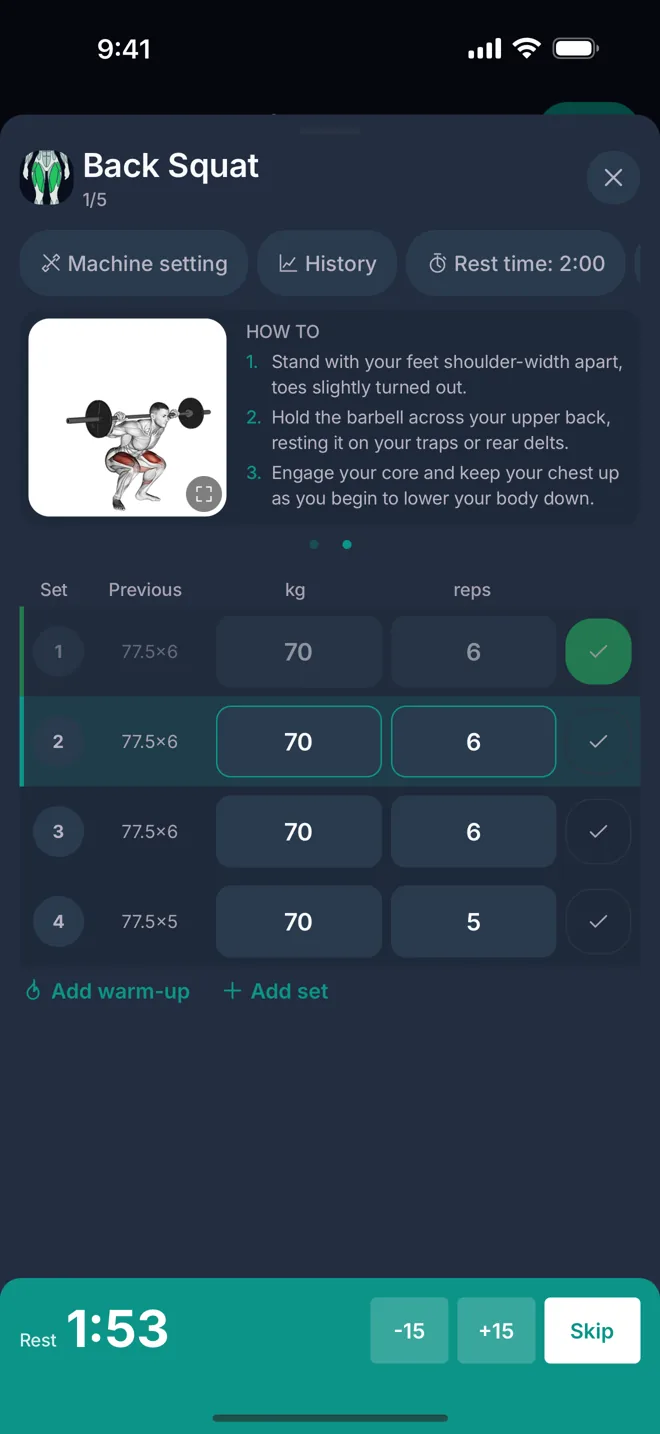
Last session's weights are already on the screen.
The rest timer lives in the Dynamic Island.
Start a set, lock the phone, and the countdown is still there. ±15 s, a sound, a notification, and the next exercise named.
21
benchmark WODs, Rx or scaled.
Fran, Cindy, Murph, DT and the rest of the Girls and Heroes — For Time, AMRAP, EMOM, For Load, Tabata, intervals, or a format you write yourself.
1,700+
exercises, with how-to animations.
229 curated movements, 433 from wger.de and 1,106 from ExerciseDB. Browse by muscle or by machine, or add your own.
Supersets and drop sets
Warm-up, working and drop sets in one flow.
Plate calculator
What to load on the bar for the next set.
Machine settings
“Seat 6, Pin 4”, saved per exercise.
Z1–Z5
Heart-rate zones
From Apple Watch or AirPods Pro 3, with time in zone.
GPS
Runs and rides
Live map, pace, elevation, laps, in the background.
0–100
Readiness score
Sleep, HRV, resting heart rate and muscle fatigue.
Training in detail
Everything on this page is in the app today.
Routines you build once
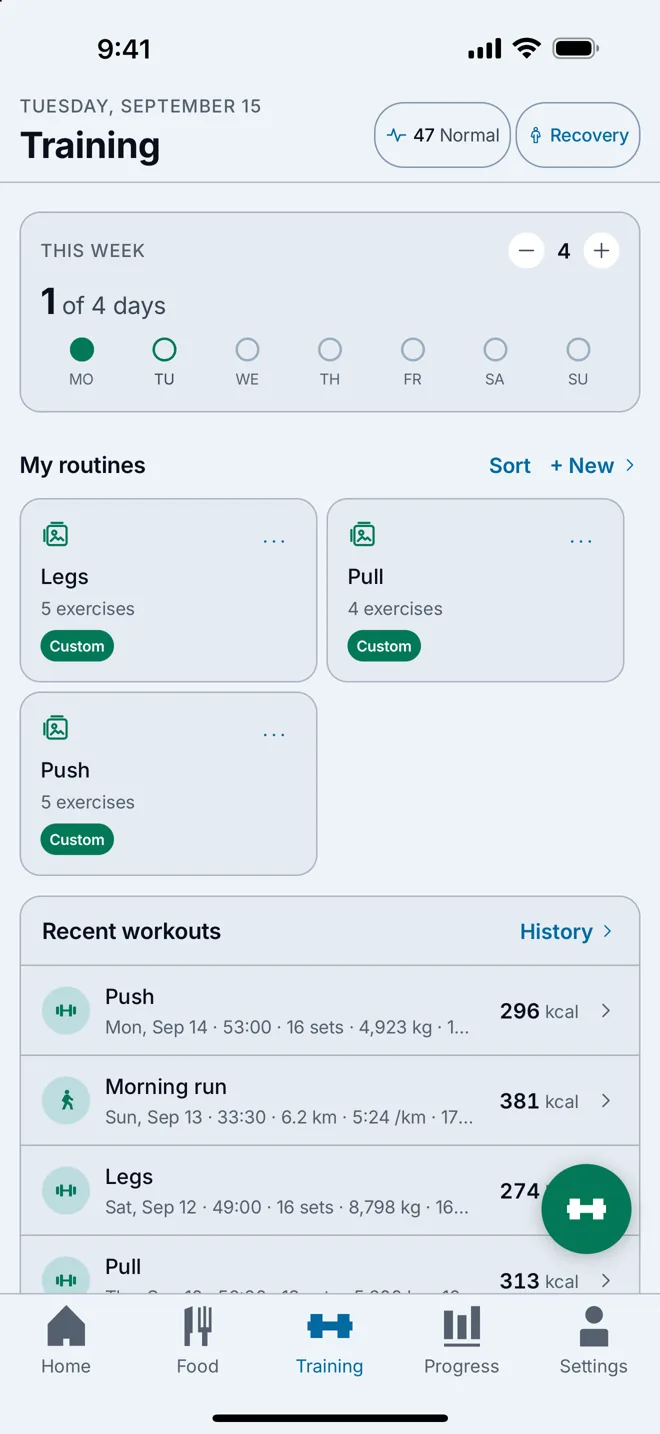
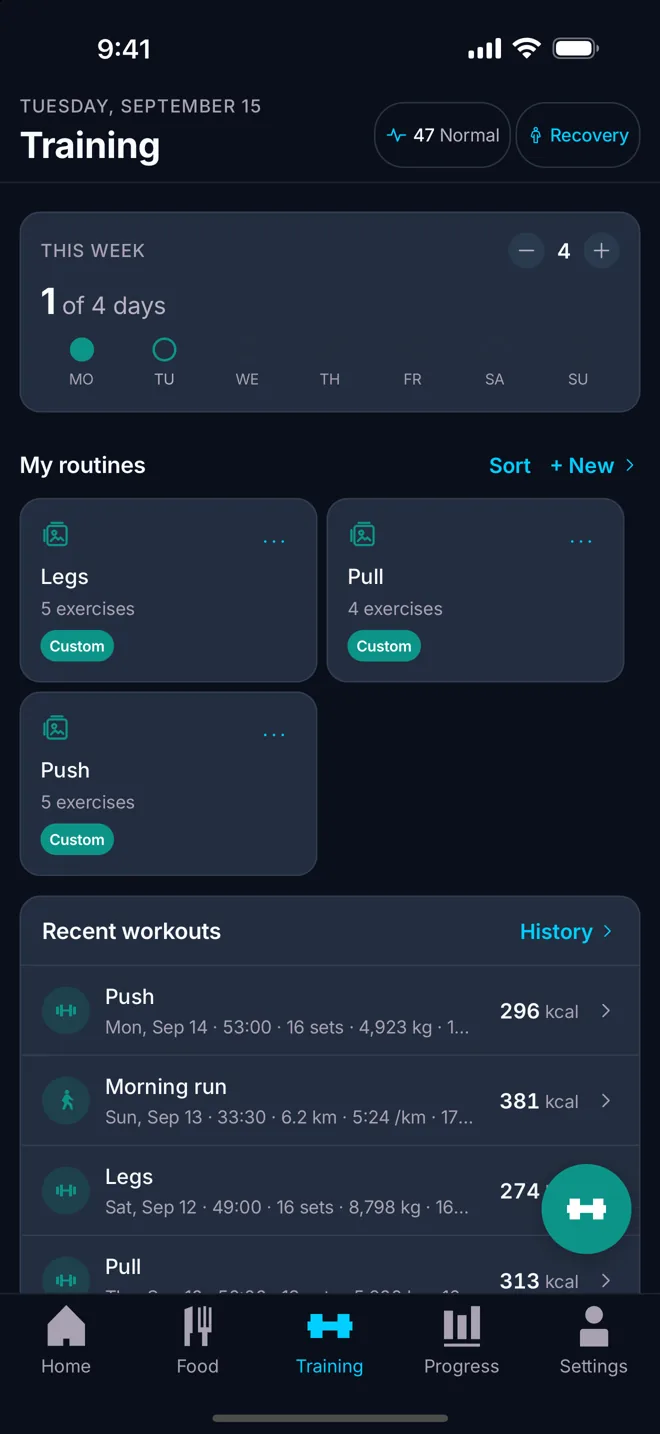
A routine is a gym session, a WOD or a cardio block, with its own icon and colour so you recognise it in the list without reading. You can share one with a link, and revoke that link later — the person who opens it sees an immutable snapshot of the routine as it was when you shared it, not whatever you have changed since.
Starting a routine opens the live workout screen. Tracked exercises are prefilled with what you actually did last time, warm-up sets and all, rather than with the numbers the routine prescribes; the prescription is only used for exercises you have never logged. That one detail removes most of the typing from a training session.
During the session you can reorder exercises, replace one with a swipe when the machine is taken, build a superset, add drop sets, and leave a note on any exercise. Machine settings live with the exercise — “Seat 6, Pin 4” is there the next time you sit down — and a plate calculator tells you what to load for the weight you entered.
A rest timer that survives the lock screen
When a set is done the rest timer starts. It runs as a Live Activity, so it is on the Lock Screen and in the Dynamic Island while the phone is in your pocket, with the next exercise named and buttons for plus and minus fifteen seconds. It ends with a sound and a notification, and it will not fire after the last set of an exercise when the session is over.
The exercise library behind all of this holds about 1,700 movements: 229 curated by us, 433 from wger.de under CC-BY-SA and 1,106 from ExerciseDB, most with a how-to animation. Browse by muscle group or by the equipment in front of you, or create an exercise of your own when the gym has something nobody has catalogued.
Functional training, properly scored
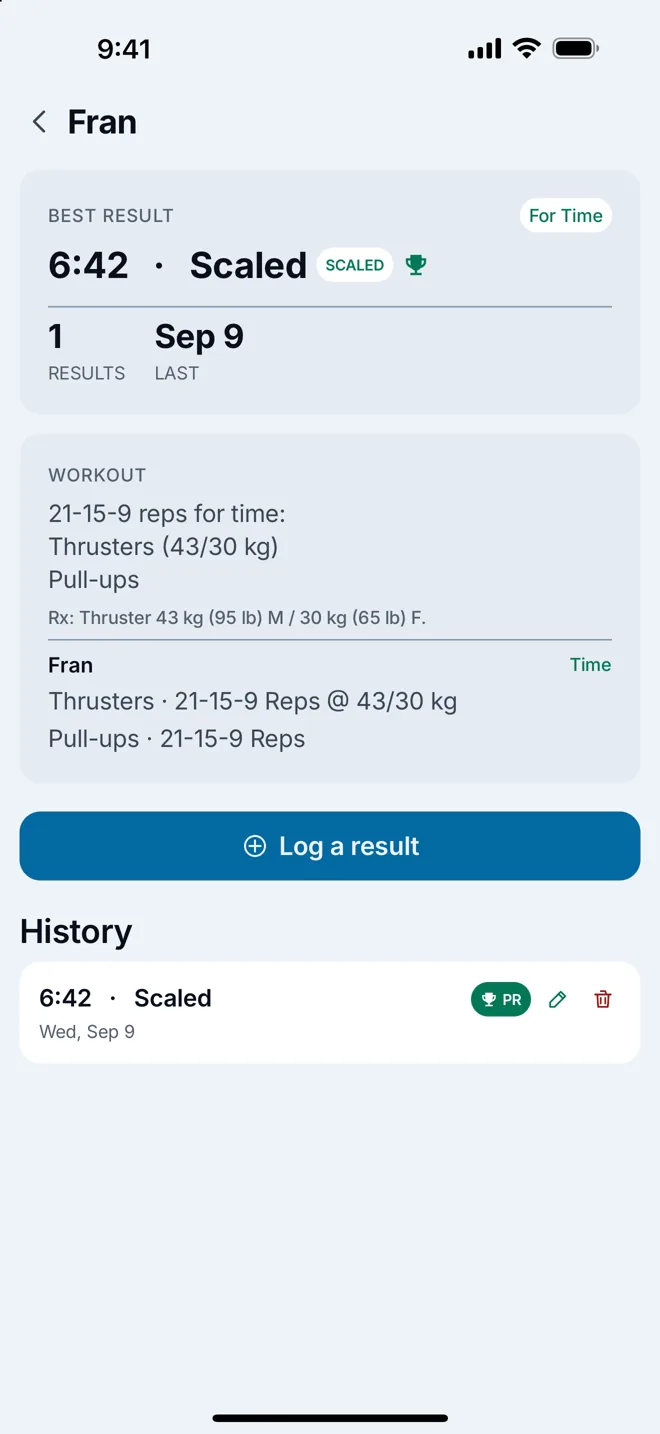
Twenty-one benchmark WODs ship with the app — the Girls and the Heroes, from Fran to Murph — and you can write your own. A WOD is text plus ordered parts, and each part has its own format and score: For Time, AMRAP, EMOM, For Load, Tabata, intervals, or something custom. Rep schemes like 21-15-9 are built by tapping chips rather than typing, each movement keeps its own unit, and For Time workouts can carry a cap.
Results are recorded as Rx, Scaled or Rx+, multi-part sessions get a timer per part, and personal records are tracked so the second attempt at Fran has something to beat.
Outside the gym, GPS runs and rides record a live map, pace, elevation and laps, and keep recording in the background. Indoor and sport sessions cover basketball, football, hiking, walking, skiing, rowing, the stair climber, the elliptical, the ski erg, the assault bike, jump rope and swimming, among others.
Heart rate, records and recovery
Heart rate streams live from an Apple Watch or AirPods Pro 3 during a session, and the time you spent in each of the five zones is broken out afterwards. Per-exercise heart-rate windows make it obvious which movement actually raised the effort.
Personal records cover the heaviest set, the estimated one-rep max and total volume, per exercise and over time. A muscle recovery map marks each group as fresh, recovering or exhausted based on what you have trained and when, and a readiness score from 0 to 100 combines sleep, heart-rate variability, resting heart rate and that muscle fatigue into one number to answer the only question that matters before a hard session.
A weekly training-days target keeps the count honest, and the history screen shows every session with per-exercise trends behind it, so a lift that has not moved in two months is visible before it becomes a plateau you have to explain.
None of this needs a watch. Heart rate, readiness and the recovery map get better with one, but a phone in a pocket records the session, the rest timer, the GPS track and the personal records on its own.